Choosing the right platform is one of the most important decisions when building a business website. For businesses in Bangladesh, two popular options are a custom website vs WordPress Bangladesh But which one is right for your business? The answer depends on your budget, business goals, required features, scalability, maintenance needs, and how much customization you need. In this guide, we’ll compare custom website vs WordPress in Bangladesh and explain the key differences so you can make an informed decision for your business.
What Is a Custom Website?
A custom website is developed specifically for a business based on its unique requirements. Instead of relying on a pre-built CMS structure or theme, developers create the website’s functionality, design, and architecture according to the project’s needs.
Custom websites can be developed using technologies such as:
- PHP
- Laravel
- React
- Node.js
- JavaScript
- MySQL
- Custom APIs
A custom solution can be useful when a business requires unique functionality that may not be easily achievable with standard WordPress plugins or themes.
What Is WordPress?
WordPress is a popular content management system (CMS) that allows businesses to create and manage websites without developing every feature from scratch.
WordPress can be extended with:
- Themes
- Plugins
- Page builders
- E-commerce solutions
- SEO plugins
- Security tools
- Custom development
For many small and medium-sized businesses, WordPress can provide a practical way to launch a professional website within a relatively limited budget.
Custom Website vs WordPress: Key Differences
When comparing WordPress vs custom website, several factors should be considered.
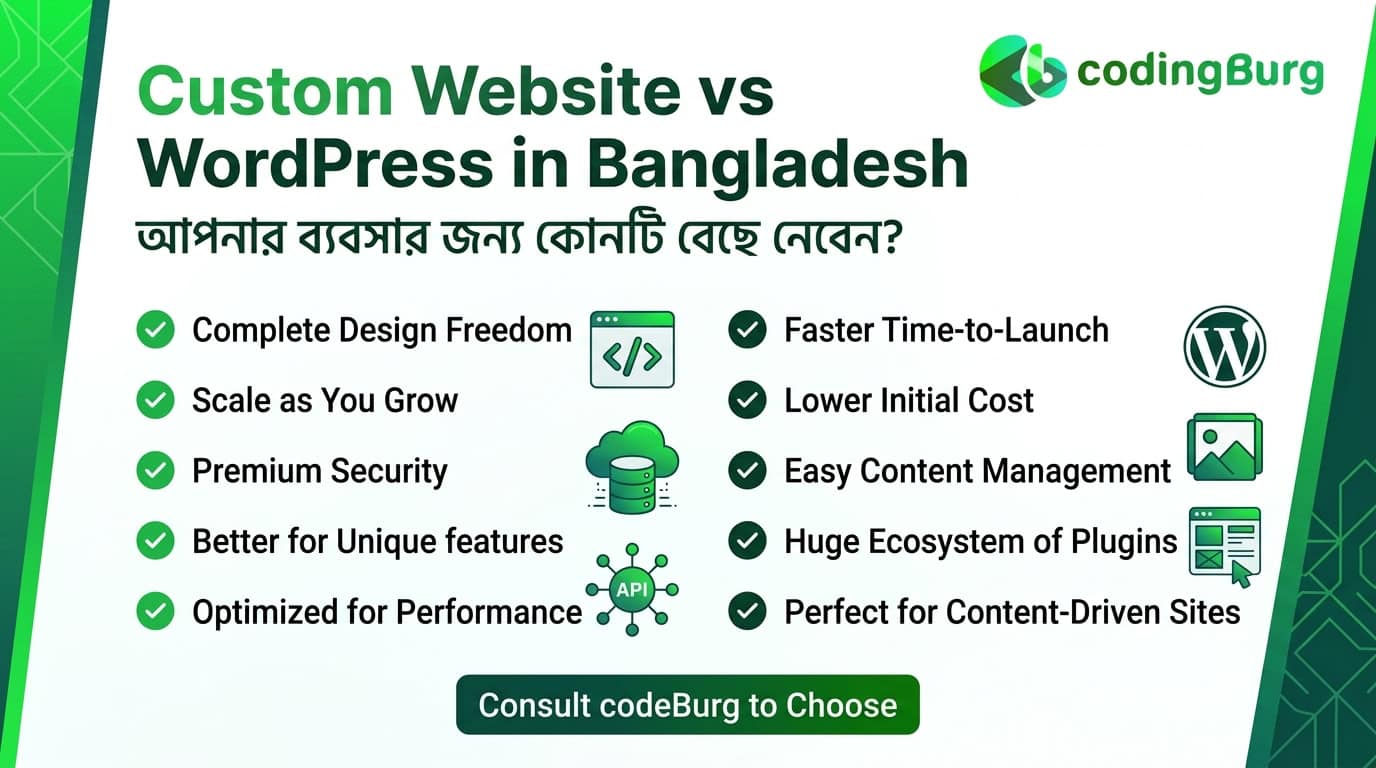
| Feature | WordPress | Custom Website |
|---|---|---|
| Initial cost | Generally lower | Generally higher |
| Development time | Usually faster | Usually longer |
| Customization | High with themes/plugins | Very high |
| Ease of content management | Easy | Depends on development |
| Plugin ecosystem | Extensive | Custom integrations |
| Scalability | Suitable for many businesses | Can be designed specifically for scale |
| Maintenance | Updates required | Developer-dependent |
| Unique functionality | May require custom development | Easier to build from scratch |
| Technical dependency | Moderate | Usually higher |
| Best for | Business sites, blogs, stores | Complex or highly customized systems |
The right choice depends on your specific requirements rather than simply choosing the more expensive technology.
WordPress vs Custom Website: Which Is More Affordable in Bangladesh?
Budget is often one of the biggest considerations for businesses in Bangladesh.
A WordPress website can often be more affordable because many components are already available, including themes, plugins, and CMS functionality.
A custom website generally requires more development time because features are built specifically for the project.
However, the total cost depends on the website’s requirements.
WordPress Costs May Include:
- Domain
- Hosting
- Premium theme
- Plugins
- Design customization
- Development
- Security
- Maintenance
Custom Website Costs May Include:
- UI/UX design
- Front-end development
- Back-end development
- Database development
- API integration
- Custom features
- Security implementation
- Testing
- Maintenance
Instead of comparing only the initial price, businesses should consider the long-term requirements of the project.
Which Option Is Faster to Build?
If you need to launch your website quickly, WordPress can often provide a faster development process.
A developer can start with an existing theme or design framework and customize it according to your brand.
A custom website usually requires more stages, including:
- Requirement analysis
- UI/UX planning
- Database planning
- Front-end development
- Back-end development
- Testing
- Security checks
- Deployment
Therefore, custom development may take longer, especially for complex projects.
Which Offers More Customization?
When it comes to customization, a custom website provides greater control over how the website works.
For example, a business may need:
- A unique booking system
- Custom customer dashboards
- Advanced membership functionality
- Complex pricing systems
- Custom CRM integration
- Specialized reporting
- Business-specific workflows
These features can be developed specifically for the business.
WordPress can also be customized extensively, but highly specialized requirements may require custom plugins or additional development.
Which Is Easier to Manage?
WordPress is generally easier for non-technical users to manage.
After development, business owners can use the WordPress dashboard to:
- Add pages
- Publish blog posts
- Upload images
- Edit content
- Manage products
- Update menus
A custom website can also have an easy-to-use administration panel, but its content management experience depends on how the system was developed.
If your team frequently updates website content, a CMS such as WordPress can be convenient.
Which Is Better for SEO?
Both WordPress and custom websites can be optimized for search engines.
SEO performance depends on factors such as:
- Website structure
- Page speed
- Mobile responsiveness
- Content quality
- Technical SEO
- Internal linking
- Metadata
- Image optimization
- Server performance
WordPress offers many SEO tools and plugins that can simplify optimization.
A custom website gives developers greater control over the underlying code and architecture, which can be useful for technically advanced SEO requirements.
The platform itself does not automatically guarantee better search rankings.
Which Is Better for E-Commerce?
For businesses selling products online, WordPress combined with WooCommerce can be a practical solution for many stores.
It can provide features such as:
- Product management
- Shopping cart
- Checkout
- Payment integration
- Order management
- Customer accounts
- Discount codes
A custom e-commerce platform may be more suitable when a business requires highly specialized functionality or complex integrations.
For example, a large business may need custom inventory management, advanced pricing rules, multiple systems integration, or specialized business workflows.
Which Is More Secure?
Security depends heavily on how the website is developed, configured, maintained, and hosted.
WordPress websites require regular attention to:
- Core updates
- Plugin updates
- Theme updates
- Strong passwords
- User permissions
- Security monitoring
- Backups
Custom websites also require secure coding, server configuration, authentication controls, updates, monitoring, and regular maintenance.
Neither option should be considered automatically secure simply because of the technology used.
WordPress vs Custom Website for Small Businesses in Bangladesh
For many small businesses, the main priorities are often affordability, fast deployment, easy content management, and a professional appearance.
A WordPress website may be suitable for businesses such as:
- Restaurants
- Local service providers
- Agencies
- Consultants
- Small retailers
- Personal brands
- Startups
- Corporate businesses
If the website mainly needs pages such as Home, About, Services, Portfolio, Blog, and Contact, WordPress can be a practical option.
When Should You Choose a Custom Website?
A custom website may be more appropriate when your business requires functionality that goes beyond a typical business website.
Consider custom development if you need:
- Complex business logic
- Custom dashboards
- Large-scale web applications
- Advanced user roles
- Complex API integrations
- Custom booking systems
- Specialized automation
- Unique workflows
- High levels of architectural control
In these situations, building a solution specifically around your business requirements may be more appropriate.
When Should You Choose WordPress?
WordPress can be a good option when your priorities include:
- Lower initial development costs
- Faster website launch
- Easy content management
- Blogging
- Business websites
- Service websites
- Portfolio websites
- Small and medium-sized e-commerce stores
- Regular content publishing
It can also be extended through custom development if the standard WordPress functionality does not meet all your requirements.
Custom Website vs WordPress: Long-Term Considerations
The initial development cost should not be the only factor when choosing a platform.
Think about your website three to five years from now.
Ask yourself:
- Will the website need new features?
- How often will content change?
- Will traffic increase?
- Will you need integrations?
- Will multiple employees manage the website?
- Will you sell products online?
- Will you need a customer dashboard?
- Will the website become part of a larger business system?
Answering these questions can help determine whether WordPress or custom development makes more sense for your business.
Common Mistakes Businesses Make
When choosing between custom website vs WordPress Bangladesh, businesses sometimes make decisions based only on price.
Other common mistakes include:
Choosing the Cheapest Developer
A lower initial price doesn’t always mean lower total cost. Consider quality, support, security, and future development requirements.
Choosing Custom Development Without a Real Need
Custom development can provide flexibility, but if your website only needs standard business features, a custom system may add unnecessary complexity.
Installing Too Many WordPress Plugins
Plugins can extend WordPress functionality, but using unnecessary or poorly maintained plugins can create maintenance and security challenges.
Ignoring Future Requirements
A website should be planned around both current and potential future requirements.
Which One Should Your Business Choose?
There is no single answer for every business.
Choose WordPress if you need a professional website, content management system, blog, portfolio, or standard e-commerce functionality and want a practical solution.
Consider a custom website if your business requires specialized functionality, complex workflows, advanced integrations, or a highly tailored web application.
The most important step is to define your business requirements before choosing the technology.
Others blog:What Is a Headless CMS? A Complete Guide for Developers
Final Thoughts
The decision between WordPress vs custom website should be based on your business goals rather than technology trends.
WordPress can provide a flexible and practical foundation for many businesses, while custom development can provide greater control for businesses with specialized requirements.
If you’re unsure which option is suitable for your business, start by listing the features, budget, timeline, and long-term goals of your project. A professional development team can then recommend an approach based on those requirements.
Discuss Your Project
Planning a new website for your business in Bangladesh?
Whether you’re considering WordPress or custom development, the right solution starts with understanding your project’s requirements.
Discuss Your Project with CodingBurg and explore the right web development approach for your business.